
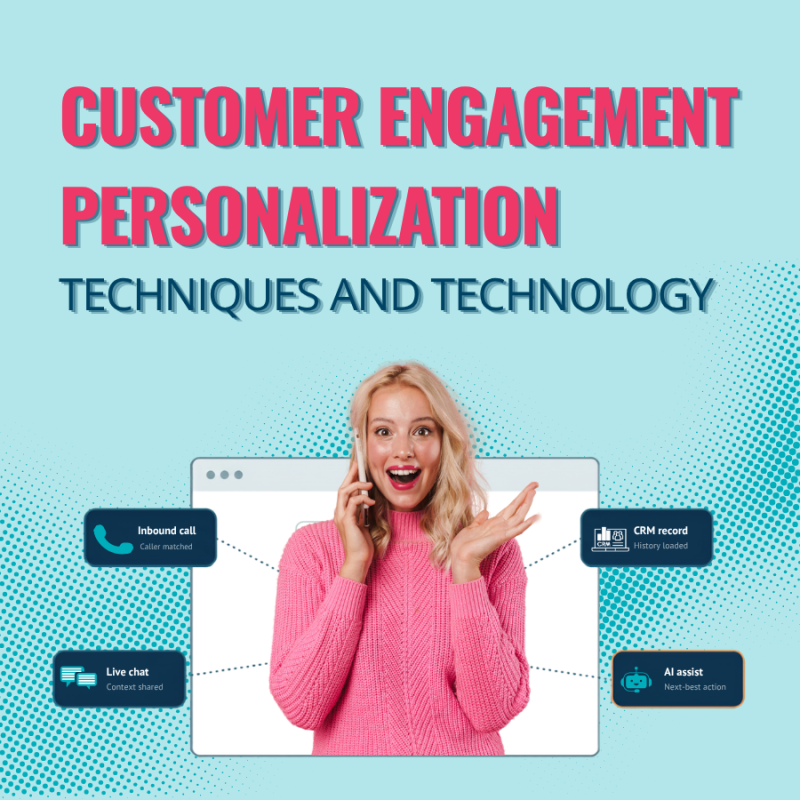
Customer engagement has become a pivotal element of business success. With an ever-growing emphasis on delivering tailored experiences, personalization has emerged as a powerful strategy to foster deeper connections with customers.
In sales and contact centers, personalization isn’t about product recommendations or email subject lines. It’s about whether the agent picking up the phone already knows who’s calling, why they’re calling, and what happened the last three times they called. That context is what separates a fast, relevant interaction from a frustrating one where the customer has to re-explain themselves to a fourth person.
What Is Personalization in a Sales or Contact Center Context?
In a contact center or sales environment, personalization means giving agents real-time access to a customer’s history, preferences, and prior interactions the moment a call, chat, or case begins, so the conversation picks up where the relationship left off instead of starting from zero. It depends less on marketing data and more on tightly connecting the CRM, the phone system, and the agent’s desktop.
How Does Personalization Improve Customer Engagement in Sales and Service?
Personalization improves engagement by removing the friction of re-identification and repetition. When agents have immediate access to account history, recent cases, and purchase or service context, through things like conversation catch-up, customers get faster resolutions, fewer transfers, and conversations that feel like a continuation rather than a cold start, which drives both satisfaction and retention. This same theory applies to agentic experiences. Your AI agent can field those lower-level calls and free up your human agents; however, that repetition when escalating will sour their experience.
Personalization Techniques for Sales and Contact Center Teams
1. Context-Aware Routing
Routing personalization directs a customer to the right agent or queue based on their history, value tier, or the reason for contact, rather than the next available agent regardless of fit.
Example: A customer with an open high-priority case is automatically routed to the agent who previously handled it, instead of starting over with someone new.
2. Behavioral and Interaction Triggers
Behavioral triggers automate next steps based on what just happened in an interaction, such as flagging a follow-up task the moment a call ends with an unresolved issue, instead of relying on the agent to remember.
Example: When an agent logs a call as “callback requested,” a follow-up task is automatically created and assigned, so nothing falls through the cracks.
3. Prioritized and Sequenced Sales Outreach
Sales teams personalize outreach by sequencing who gets contacted, when, and in what order based on deal stage, engagement signals, and account value, rather than working straight down a generic call list.
Example: A rep’s queue surfaces the prospect who just re-engaged with a proposal ahead of a colder lead that’s simply next alphabetically.
4. Contextual Escalation
Escalation personalization carries the intent, history, and prior conversation forward when a case moves from one channel or one agent to another, instead of resetting at the handoff.
Example: A self-service interaction that can’t be fully resolved hands off to a live agent along with a summary of what was already tried, instead of the customer starting over.
5. Proactive Follow-Up
Proactive follow-up uses what’s known about a customer’s situation to reach out before they have to ask, rather than waiting for the next inbound contact.
Example: A customer whose case was left open at the end of a shift gets a scheduled callback instead of having to call back in themselves.
Technologies Driving Personalization in Contact Centers
1. CTI (Computer Telephony Integration)
CTI connects the phone system to the CRM, which is what makes real-time customer context possible in the first place. The clearest example is the screen pop: the moment a call, chat, or email comes in, CTI matches it to the right CRM record by phone number or account ID and surfaces it automatically, so agents aren’t manually searching for who they’re talking to. Without this connection, agents are working from two disconnected systems instead of one.
Example: A call center agent receives an inbound call, and the customer’s full record, including order history and prior tickets, opens automatically before the first word is spoken.
2. CRM Systems
CRM systems store the customer history, preferences, and interaction records that personalization depends on. This is what gives agents and reps a single, real-time view of the customer the moment an interaction starts, rather than piecing the picture together by hand. The CRM is the source of truth; CTI and orchestration tools are what make that data usable in the moment.
Example: A CRM gives an agent visibility into every past interaction across phone, email, and chat, so nothing has to be re-asked.
3. AI and Real-Time Transcription
AI and real-time transcription analyze conversations as they happen, surfacing relevant account details, suggested responses, or next-best actions to the agent in real time, rather than after the call ends.
Example: During a call, AI flags a relevant policy or past complaint based on what the customer is currently saying, before the agent has to ask.
4. Orchestration Platforms
Orchestration platforms connect CRM, CCaaS/telephony, and AI services into one coordinated layer, so customer context, agent state, and interaction history all inform what happens next across every channel, not just one.
Example: A platform connects a customer’s chat history to their phone interaction, so a rep who picks up a call already knows what was discussed in the earlier chat.
5. Omnichannel Integration
Omnichannel integration ties voice, chat, email, and SMS into a single underlying interaction history, which is what makes techniques like contextual escalation and proactive follow-up possible across channels instead of just within one.
Example: A customer who emails about an issue, then calls to follow up, doesn’t have to re-explain anything, because the agent sees both interactions in one timeline.
6. AI Voice Agents with Contextual Handoff
The newest layer of personalization extends context into AI-driven voice interactions themselves, not just human ones. A voice gateway can route calls into an AI agent for resolution, then hand off to a live agent with the caller’s intent, transcript, and routing history intact, so the human agent isn’t starting cold even when an AI handled the first part of the conversation.
Example: A customer calls in, and an AI voice agent resolves a status check or scheduling request directly. If the issue needs a human, the call transfers to an agent who already has the transcript and context, instead of asking the customer to repeat themselves.
This is the kind of integration work that tends to separate a successful AI voice rollout from a stalled one. Connecting existing SIP, SBC, or CCaaS infrastructure into a platform like Salesforce’s Agentforce Voice without disrupting current routing or telephony investments requires careful planning around voice routing, media paths, failover, and escalation logic. That’s typically where a consulting partner with deep telephony and CRM integration experience, rather than a product alone, makes the difference between a working pilot and a stalled one.
CTI vs. CRM vs. Orchestration Platforms
These terms get used interchangeably, but they solve different problems:
| Technology | Best for | What it personalizes |
|---|---|---|
| CRM | Storing customer history, preferences, and account data | The single source of truth agents and reps pull from |
| CTI | Connecting telephony/CCaaS systems to the CRM | Screen pops, click-to-dial, real-time caller matching |
| Orchestration Platform | Coordinating CRM, CCaaS, and AI across channels | Cross-channel context, next-best-action, agent workflows |
| AI Voice Gateway | Bridging existing telephony into AI voice agents | Self-service resolution plus contextual handoff to a live agent |
Most mature contact center personalization programs use these together: CRM as the data backbone, CTI as the connective layer, orchestration to keep context consistent across channels, and increasingly, AI voice gateways to extend that same context into automated voice interactions.
Quick-Start Checklist for Sales and Contact Center Teams
- Audit which systems agents currently have to toggle between manually; that’s usually where personalization is breaking down
- Start with screen pops on your highest-volume contact channel (phone is usually the highest-impact starting point)
- Make sure interaction history carries across channels, not just within one (a customer shouldn’t lose context switching from chat to phone)
- Use routing rules to send returning customers back to an agent with prior context when possible, not just the next available agent
- Pilot one AI-assisted capability, such as real-time transcription, next-best-action prompts, or a bounded AI voice agent for a single call reason, on a single team before rolling out broadly
- Plan escalation paths before launch, so AI-to-human handoffs carry transcript and intent rather than dropping context at the transfer
- Revisit integration gaps quarterly as CRM, CCaaS, and AI tools continue to evolve faster than most environments are updated
Getting Started
Personalization in sales and contact centers is about whether the systems agents (and increasingly, AI agents) rely on are actually connected. Unified customer context, screen pops, cross-channel history, and now AI voice agents with proper handoff all turn every interaction into a continuation of the relationship instead of a reset.
The hardest part is rarely choosing the technology; it’s connecting it to the telephony, CRM, and routing systems already in place without disrupting what’s working. That’s where a consulting-led approach matters: starting with a clear-eyed discovery of the current environment, validating routing and failover before going live, and expanding scope incrementally rather than attempting a full rollout on day one. Start with the disconnect that’s costing agents the most time, whether that’s a missing screen pop, a context gap between channels, or a stalled AI pilot, and build outward from there.
Interested in taking the next step? Talk to an AMC Technology Expert
