
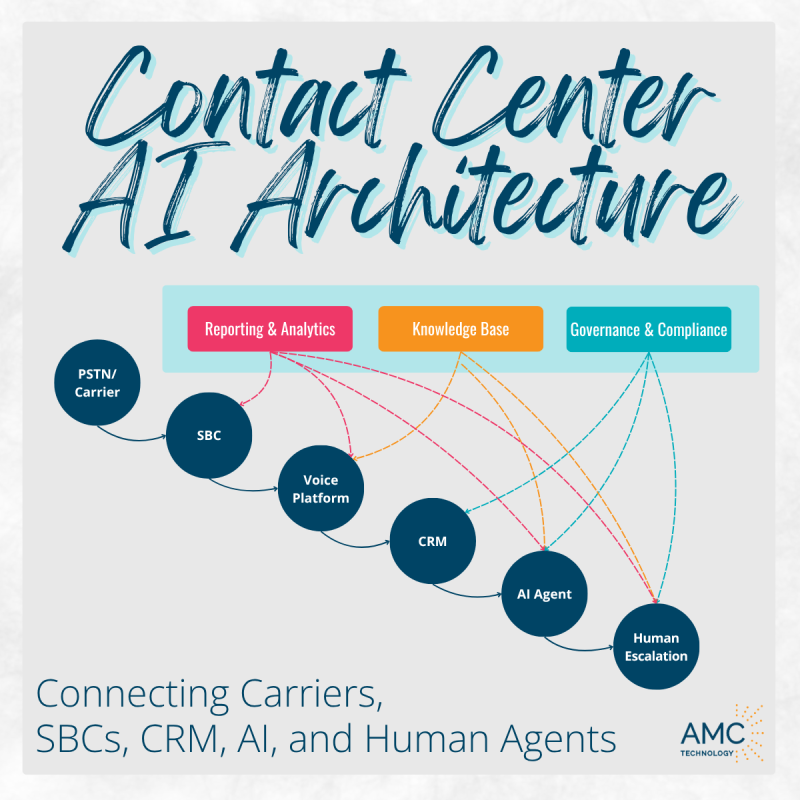
A contact center AI architecture can look deceptively clean on a diagram. A carrier delivers the call, an SBC controls the boundary, a voice platform routes it, Salesforce holds customer context, an AI agent handles the conversation, and a human agent takes over when needed.
Follow the Interaction Through the Contact Center AI Architecture

The difficulty sits in the connections between them.
Each connection carries information from one system to another. Depending on the architecture, that can include audio, call identifiers, routing state, customer records, transcripts, authentication results, agent availability, recordings, and the history of what already happened during the interaction.
Each handoff has four jobs: move the required data, translate it when the next system expects a different format, protect it in transit, and preserve enough context for the interaction to continue. A failure in any one of those jobs can break an otherwise functioning stack.
That makes contact center AI architecture a cross-system design problem. Voice teams may own carriers, SIP, SBCs, and routing. CRM teams may own Salesforce data and workflows. AI teams may own models, prompts, knowledge, and automation. The architecture still needs to connect those responsibilities into one interaction.
For organizations with existing enterprise voice infrastructure, that often means understanding what they can keep, what they need to connect, and where AI orchestration needs to sit before implementation begins.
PSTN / Carrier: Where the Call Enters
The carrier gets the call from the public network into the enterprise voice environment.
For the architecture downstream, the important details include where the carrier sends the media and signaling, which identifiers travel with the call, and which route takes over during a failure. Direct SIP trunks give an organization control over carrier relationships and routing, while the organization or its integration partner manages redundancy and failover.
The SBC receives that traffic and controls what happens next.
Session Border Control (SBC): Connecting Enterprise Voice to AI
The session border controller sits between external voice networks and the enterprise environment. It handles functions such as SIP signaling, security, routing, and, where required, media or codec handling.
When an organization adds AI voice to an existing environment, the SBC can become the point where the call takes a new path.
The SBC can route the voice stream and associated call information toward an AI orchestration layer. The downstream system needs to understand what the SBC sends, so the architecture needs to maintain the expected media format, keep call information connected to the interaction, and protect the connection according to the organization’s security requirements.
The SBC therefore plays a direct role in contact center AI architecture. Its routing and media configuration determine how a live voice interaction reaches the systems that will process it next.
Voice Platform: Adding AI to Existing Contact Center Infrastructure
The voice platform handles queues, routing, recordings, transfers, agent state, IVR behavior, and other call-control functions.
Enterprises configure this layer in many different ways. One organization may run most routing inside a CCaaS platform, while another may use on-premises telephony connected to Salesforce. A third may divide routing decisions between its voice platform and CRM. AI introduces another destination for the interaction.
Enterprise voice environments do not produce one universal package of audio, signaling, and call information that every AI platform accepts. Different combinations of carriers, SBCs, contact center platforms, configurations, and CRM systems produce different inputs.
That variation creates the need for AI orchestration.
Where AI Orchestration Fits in Contact Center AI Architecture
AI orchestration manages the translation and coordination that happen between voice, CRM, and AI systems.
In practice, that can include receiving media and call information from the voice environment, normalizing those inputs into the format the AI service expects, passing relevant context into Salesforce, and keeping interaction state aligned as the call moves between systems.
The orchestration layer also helps preserve continuity when the call changes direction. If an AI agent transfers the interaction to a human, the surrounding systems need to carry forward the right context, routing information, and CRM state instead of treating the transfer as a separate event.
This becomes especially important in enterprise AI architecture because many organizations already have carriers, SBCs, voice platforms, Salesforce, and established routing logic in place. The project may only require new connections between those systems rather than a broader replacement of the voice environment.
AMC Technology’s consulting work focuses on defining those connection points, the data and media that cross them, and the system behavior required to keep the interaction synchronized from entry through escalation.
CRM: Connecting Customer Context
A phone call becomes more useful once Salesforce or another CRM connects it with the customer and the work surrounding that customer.
The CRM may connect the interaction with a contact, account, case, previous conversations, authentication state, or other business records. That context can support screen pops, workflows, routing decisions, reporting, and AI actions.
Synchronization becomes important when different systems own different parts of the interaction. If the voice platform owns routing while Salesforce owns customer state, the two systems need a reliable way to exchange changes.
When an agent changes state, the routing system needs the correct status. When a call transfers, the systems need to move the appropriate customer context with it. When a workflow changes the next action, every system involved needs to receive that update.
A toolbar can appear to work while the systems behind it hold different versions of the interaction. Enterprise AI architecture therefore needs to account for system state as well as the visible agent experience.
AI Agent: Define the Data Around the Conversation
An AI voice agent may need customer identity, case history, knowledge, authentication state, previous actions, and permission to perform specific CRM operations. It also needs rules that tell it when to transfer an interaction or stop attempting an action. If the AI receives incomplete or stale context, improving conversational behavior will not repair the missing information.
The AI layer needs a defined data contract with the systems around it. That contract should specify which system supplies customer and case context, which CRM actions the AI can perform, which actions require authentication or approval, what information can enter transcripts, and where the AI writes the interaction record after the call.
For an Agentforce deployment, this means the architecture extends beyond the Agentforce agent itself. Salesforce, the voice environment, knowledge sources, routing, and the human escalation path all contribute information or behavior that affects the interaction.
Human Escalation: Moving Context With the Call
Architecture diagrams often reduce escalation to a single arrow:
AI Agent → Human Agent
Moving the audio only solves part of the transfer. When the call reaches a human agent, that agent may need the customer identity, reason for contact, authentication status, transcript or summary, actions already attempted, relevant Salesforce record, and transfer reason.
If the systems transfer the audio while leaving that information behind, the customer has to reconstruct the interaction for the next agent. The systems also lose information that teams may need later for reporting and troubleshooting.
Teams should define the human escalation path while they design the AI interaction. During testing, they can inspect what appears on the agent’s screen when the transfer arrives, which fields populate, whether the transcript or summary follows the call, which CRM record opens, and whether the agent can see what the AI already attempted. A successful handoff preserves both the call and the context needed to continue it.
Account for the Systems Around the Interaction
The call path only shows part of the enterprise AI architecture. Knowledge, reporting, and governance also need to work across the systems involved.
Knowledge: Define the Source of Truth
AI and human agents need consistent information if customers expect consistent answers.
Organizations may use different interfaces or repositories across the contact center. They still need to identify which source governs an answer and how updates reach every system that uses that information.
Consider a policy change. The content team updates the agent knowledge base on Monday, while the AI continues using an older source until Thursday. Both systems follow their configurations correctly, yet customers receive different answers depending on who handles the interaction.
The architecture needs a defined source of truth for knowledge, CRM state, routing rules, and authentication status. When multiple systems can update the same information, teams also need rules that determine which system takes precedence.
Reporting: Connect One Interaction Across the Architecture
Each platform reports on the portion of the interaction it owns. The carrier can report traffic, the voice platform can report calls and queues, Salesforce can report customer and case activity, and the AI platform can report its own interactions.
Useful contact center reporting has to connect events across those systems.
Teams need a shared interaction identifier, or a reliable way to map the identifiers that each platform creates, so they can connect the initial call with AI activity, transfers, CRM work, and eventual resolution.
Without that relationship, teams have to reconcile data before they can analyze the full interaction. A dashboard can only connect what the underlying architecture allows the reporting layer to identify as the same interaction.
Governance: Follow the Data Across Each Connection
Enterprise AI architecture introduces governance requirements anywhere systems exchange customer data, recordings, transcripts, authentication information, or AI-generated content.
Someone needs authority over AI prompts and behavior. Someone owns routing rules. Someone approves changes to knowledge. Someone determines escalation thresholds. Someone controls access to recordings, transcripts, and customer data.
Security teams also need to follow the connections between systems. During an architectural review, teams can examine the protocols that systems use to communicate, where they transform data, what information crosses each boundary, and where that information could become exposed.
Documenting each exchange makes that review more concrete:
System A → data exchanged → protocol → transformation → System B
That gives security, infrastructure, contact center, CRM, and AI teams the same interaction path to inspect.
Prepare the Architecture for Production
Test the Full Interaction
Production testing should follow the interaction across media, routing, CRM updates, AI behavior, and human escalation. Teams should also test failure scenarios to confirm that calls follow the expected fallback path and context survives transfers.
Testing the complete path exposes integration problems that individual platform tests can miss.
At AMC Technology, we pilot every deployment to ensure the plumbing works exactly as the architecture proposes. Learn More About Pilots
Define What Needs to Change
Existing infrastructure adds another layer to AI implementation. An enterprise may already have SIP carriers, SBCs, telephony or CCaaS, Salesforce, routing logic, security controls, and established human-agent workflows that need to remain in place.
Adding AI requires teams to define how it enters the call path, which system controls routing, how Salesforce and the AI exchange context, and what follows the interaction when it reaches a human agent. Mapping those handoffs shows where the existing architecture can stay in place and where the project requires a new connection or change.
Plan Your Contact Center AI Architecture With AMC Technology
AMC Technology’s Blueprinting Services map the voice, CRM, and contact center environment across call paths, routing, integrations, data exchanges, security boundaries, human escalation, and failure scenarios.
The resulting architecture gives teams a technical plan for connecting AI to their existing environment before implementation begins.
